Himan Music (also referred to at different times as Hi-Man Music and Heiman Music) was the brainchild of the Latvian-born
Israeli musician and composer Nachum Heiman.
Born in 1934, he had scored an early commercial success in the music
industry as co-writer of the song 'Le Jour Ou La Colombie', which was
recorded by the Greek singer Nana Mouskouri in 1967.
Moving to London in 1971, he continued to write music for film
and television including a library album called Percussion Workshop for
publishers KPM. Wanting to
be his own boss, Nachum (who was also known as Nick) set up his own
company in 1975 on an initial investment of £400 to produce
jingle-length library music pieces for use in adverts.
By the following year Himan Music had become affiliated with a
new music publisher named Fuse Music that was handling the publishing
for both Genesis and Peter Gabriel amongst others.
Through this connection, Ant was given the opportunity to write
and record some short pieces of music of around 30 seconds duration for
Himan as jingles for potential use on adverts.
1976 Jingles production
Recorded in the Summer of 1976 at Send Barns
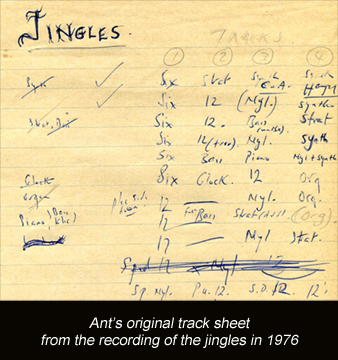 Ant wrote and recorded a number of pieces in this genre
in the Summer of 1976 for
what would be his first library music project, taping the tracks on 4-track
in his home studio at Send Barns. In this early period there was
no music issued on vinyl LPs and Himan Music would make material
available to their clients on quarter-inch tape.
Rather than give the tracks individual titles, a series of
reference numbers were instead allocated to the individual pieces for
the purpose of identifying them. Ant's notes from the time
indicate that sixteen of the tracks that he wrote and recorded for this
project were given these numbers, with variant mixes of a track having an 'A' added to
them.
Ant wrote and recorded a number of pieces in this genre
in the Summer of 1976 for
what would be his first library music project, taping the tracks on 4-track
in his home studio at Send Barns. In this early period there was
no music issued on vinyl LPs and Himan Music would make material
available to their clients on quarter-inch tape.
Rather than give the tracks individual titles, a series of
reference numbers were instead allocated to the individual pieces for
the purpose of identifying them. Ant's notes from the time
indicate that sixteen of the tracks that he wrote and recorded for this
project were given these numbers, with variant mixes of a track having an 'A' added to
them.
Many of the tracks recorded for this project have not been released in any form but the following pieces from it would appear elsewhere later on, with four of them also receiving a release on Ant's commercial albums.
AP 3004 was released in a newly mixed form as Romeo and Juliet on
Archive Collection Volume Two
AP 3005
was subsequently released on the 1990 Atmosphere library CD Christmas,
Kids and Comedy (ATMOS-CD15), where it was included as Lullaby 1.
The track was later released as Marionette Vignette on
Private Parts & Extra
Pieces I
AP 3015 was also released on Christmas, Kids and Comedy
as Lullaby 2. The track was later released on
Private Parts & Extra
Pieces I
Himan Music would subsequently promote this first project the following
year by issuing a quarter-inch tape compilation of fifteen tracks
from it as one of a number of such titles issued in a series that they called "Jingletime". Each track was identified by a voiceover recorded by Nachum
Heiman, which stated the reference number given to it.
The label on the tape box for the "Jingletime" compilation read
as follows:
Anthony Phillips in “Jingletime” is the fourth
in our series of productions in which today’s pop groups are recording
jingle length music in their own styles.
This production features Anthony Phillips, one
of the original members of the group ‘Genesis’.
He is now a multi-instrumentalist and composer in his own right,
and his first solo album will be released here shortly.
1977 Jingles production
The following year Ant wrote and recorded another smaller selection of jingle length pieces for Himan Music in a similar style to the tracks he had produced the previous year. Further details about the tracks such as any reference numbers that Himan may have allocated to them are unknown and none of these pieces have been released in any form.
1979 Library Music production
Recorded in the Summer of 1979 at Atmosphere
Studios, Lexington Street, London
Ant's next project for Himan Music would be recorded in the summer of 1979
after he had returned from a trip to the USA where he had given a number
of radio and press interviews to promote the release of Sides.
As he recalls, this opportunity to work on the library project
came at a time where he was unsure where his future musical direction
lay: "I was a little bit of a lost soul at that point because Sides
hadn't really set the world alight and the music scene was changing so I
wasn't sure where I was going.
So for that library project I was allowed to potter about and use
a studio in the evenings and small hours to record the tracks."
 In
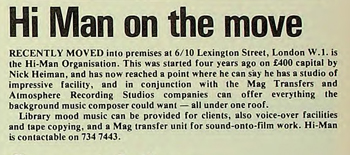
the spring of 1979 Himan had acquired some new premises in Lexington
Street in the West End of London, with Atmosphere Recording Studios and
Mag Transfers being establised as divisions of the parent company.
This arrangement gave Himan two fully equipped recording studios and a
magnetic transfer unit to cater for film
sound work. Working with
engineer John Reiner in this new facility, Ant recorded a large number
of pieces for the library production which once again were subsequently made
available for use by broadcasters and advertising agencies on
quarter-inch tape. Drums and
percussion parts played by a drummer (whose name is currently elusive)
were also added to some of the tracks.
In
the spring of 1979 Himan had acquired some new premises in Lexington
Street in the West End of London, with Atmosphere Recording Studios and
Mag Transfers being establised as divisions of the parent company.
This arrangement gave Himan two fully equipped recording studios and a
magnetic transfer unit to cater for film
sound work. Working with
engineer John Reiner in this new facility, Ant recorded a large number
of pieces for the library production which once again were subsequently made
available for use by broadcasters and advertising agencies on
quarter-inch tape. Drums and
percussion parts played by a drummer (whose name is currently elusive)
were also added to some of the tracks.
For the project Ant recorded a mixture of pieces of different duration,
some being of the usual jingle length of around 30 seconds with others
being of a longer duration.
Variant mixes of some tracks were also made during the sessions
which resulted in some cases of there being a number of different
versions of the same piece. For
example, the track recorded under the working title of 'Scottish Theme'
(which was subsequently released on Archive Collection Volume 2 as Highland Fling) was recorded in both short (around 30 seconds) and long
versions (around 90 seconds). Three
mixes of the 30 second version and two mixes of the 90 second version
were then made.
The tracks were given working titles by Ant in order to identify them, with Himan later allocating reference numbers to the pieces which took a shorter form than those used for the 1976 project. When Himan Music was subsequently absorbed into Atmosphere Music, the pieces were registered for copyright purposes under new titles in the Spring of 1982, although it is not known exactly which titles were given to all of the tracks.
As with the 1976 production, many of the tracks recorded for this project have not been released in any form but the following pieces from it would appear elsewhere later on and several of them would also receive a release on Ant's commercial albums. The titles listed in quotes are Ant's original working titles for the pieces.
"Elgar Classical" - two variations of this track were subsequently
released on Finger Painting as A Song (0:36)
"Our Man In Japan" was given the reference number AP 37a by Himan Music. Subsequently titled Gliding by Atmosphere, it was issued on their first vinyl LP release Electronic Music (ATMOS 001) in 1983 and was later released on Finger Painting as Tierra Del Fuego.
"Computers on Ice" was given the reference number AP 55 by Himan and in this incarnation was used both on a television advert for the company Weatherseal and also in the 1980 short film Great North Face Air Race, which documented various attempts to race down the North Face of the Eiger mountain. The film was shown in cinemas as a supporting feature and was later broadcast on television. Given the new title of Abstract Atmospheric by Atmosphere, it was issued on their first vinyl LP release Electronic Music (ATMOS 001) in 1983 and then on the 1989 library CD Soft Science (ATMOS-CD7). It was given a commercial release on Archive Collection Volume Two in 2004 as Polar Lights.
"Scottish Theme" - a 30 second version of this track was included on the 1983 Atmosphere LP Landscape (ATMOS 005) as Highland Melody. In 2004 a longer version of the track (1:52) was released as Highland Fling on Archive Collection Volume Two. The track had originally been written as a potential piece for inclusion on Sides the previous year.
"South Pole" - later titled Ice by Atmosphere and issued on the LP release Electronic Music (ATMOS 001) in 1983.
"Snow" - two variant mixes of this track were also released on Electronic Music as Arctic Waste and Arctic Waste (B) respectively.
"Annette" was subsequently given the title of French Love Theme by Atmosphere and one version of it was picked up for use on a television advert for the beauty product Oil of Ulay. In 1989 Ant created an extended version of the track (dur 2:07) which combined a solo piano recording with a fuller version in reverse, for inclusion as Paradise Found on Finger Painting.
"Chinese Wanderer" (as Our Man In Japan - not to be confused with the working title for the library track Gliding mentioned above) and "Fauré" (as Lofty Vaults) were both released on Archive Collection Volume Two in 2004
Another track from this production without a working title was used on an advert for Lucozade that was shown
exclusively in the Far East.
Ant remembers that the advert had four different directors who argued
and contradicted each other!
As well as the writing and recording of jingles and pieces of library
music by the composers that worked with them, Himan Music had begun to
pick up commissions for providing original music for television programmes.
Through this route and with Ant being one of the few Himan composers who had some experience
of classical music, his name was put forward to write the music for the ATV series Rule
Britannia, for which he would go on to write and recorded the music in October 1980.
After Atmosphere Music had been established other commission pieces would follow
in subsequent years, including the music for
an advert for New Zealand Lamb
1981 Small Orchestral Library
Music Project
Recorded in May 1981 at Atmosphere Studios,
Lexington Street, London.
Following the completion of work on 1984, for his next library music project Ant was asked to write and arrange a selection of pieces for a small orchestral group. The pieces were recorded at Atmosphere Studios by various session players including the members of the Gabrieli String Quartet, with the assembled musicians being conducted by Ant's friend Jeremy Gilbert.
A couple of the pieces from this project were used on the six-part TV series "How We Learned To Ski", which was broadcast on Channel 4 in the UK in November and December 1983.
Following the recording of these orchestral pieces, Atmosphere Music was formally
registered as a company in June 1981 and in due course took over the
whole catalogue of library pieces recorded under the auspices of Himan
Music. Nachum Heiman went on
to sell his share in the company and moved on to another musical
enterprise after he met the Swiss entrepreneur and
musician Patrick Mimran, who had acquired the car firm Lamborghini in
1979. In 1982 the pair of
them teamed up to form Lamborghini Records, which was officially
launched in March the following year.
The label signed up a selection of artists including Steve
Hackett (with Lamborghini releasing his albums Bay of Kings and Till We
Have Faces) but after a couple of years of minimal commercial success
the label was closed down.
Nachum subsequently returned to live in his native Israel where he
continued to write and record music as well as becoming involved in the
preservation of traditional Hebrew folk songs.
He died in August 2016, aged 82.
1981 Jingles
Recorded in August 1981 at Send Barns
Ant's final jingles during this early era of library music were recorded
on 8-track during the last sessions at Send prior to him relocating to London.
As well as tracks like Eduardo and The Sea & The Armadillo, which
would see the light of day on A Catch At The Tables, he also recorded a
couple more jingle length pieces with a view to them being used on the
broadcast coverage of the football World Cup that was taking place in
Spain the following year. Neither of these tracks have been
released in any form.